Blog · November 15, 2026 · Fake AI apps
Fake ChatGPT, fake Grok, fake Brave Talk: three disk images, three techniques
Four disk images named after well-known apps carry code no honest app needs, each hidden in a different way, and MacVigil found it without opening them.
Say you are looking for the ChatGPT app for your Mac. A sponsored link, a polished page, a file called ChatGPT_1.2026.118.dmg. The name is right and the version number looks real. What is inside has nothing to do with ChatGPT.
We collected four disk images, first seen between September 18 and November 5, 2026, and gave them to MacVigil. None of them was mounted or opened. All four come out dangerous, from 88 to 100 out of 100, by behavior alone: with Apple’s XProtect, MacVigil’s list of known-malware fingerprints and its DeepBranch AI second opinion all switched off. Behind the same storefront, they do different things. The fake ChatGPT and MacSetup.dmg carry the stealer described in MioLab Stealer, decrypted: the same code, with the same servers written in it.
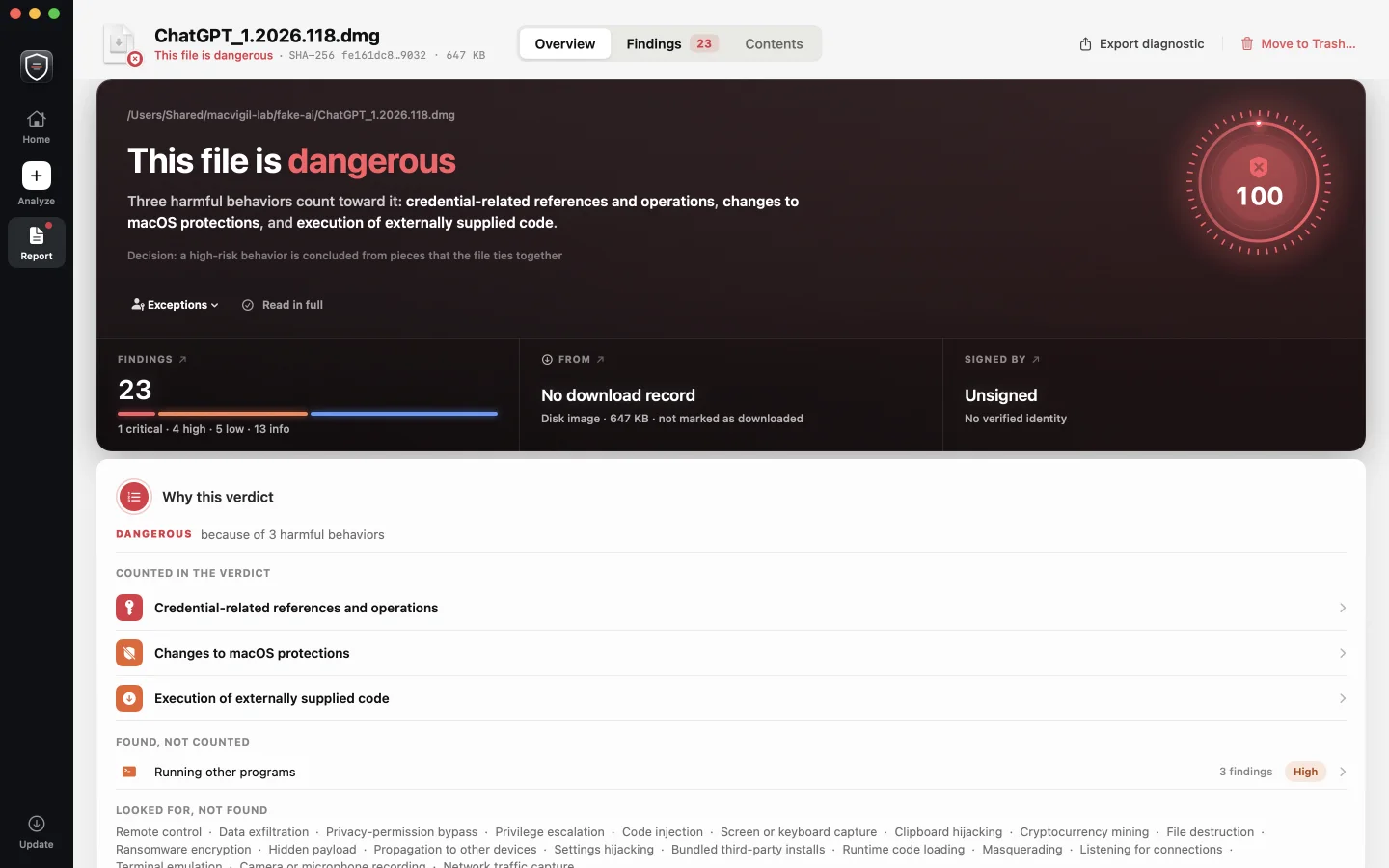
Fake ChatGPT: the encrypted configuration
MacVigil opens the image without mounting it and reads ChatGPT.app/Contents/MacOS/ChatGPT. The strings this program works from are not all written in the file: some are encrypted, and the program carries the code that decodes them. MacVigil does the decoding itself and finds two things the program would act on:
• cookies.sqlite : Credential-related references and operations
• killall Terminal 2>/dev/null : Changes to macOS protections
Firefox’s cookie database, and the command that closes Terminal. MacVigil also follows commands to the call that would run them. One of them is a dialog whose answer is hidden as it is typed:
popen("…1…2 buttons {"Continue"} default button "Continue" with title "…3" with hidden answer' 2>/dev/null")Each … stands for a part the program joins into the line at run time and that MacVigil did not read. A chat app has no reason to ask you to type something hidden, such as a password, in a dialog of its own, or to close your Terminal.
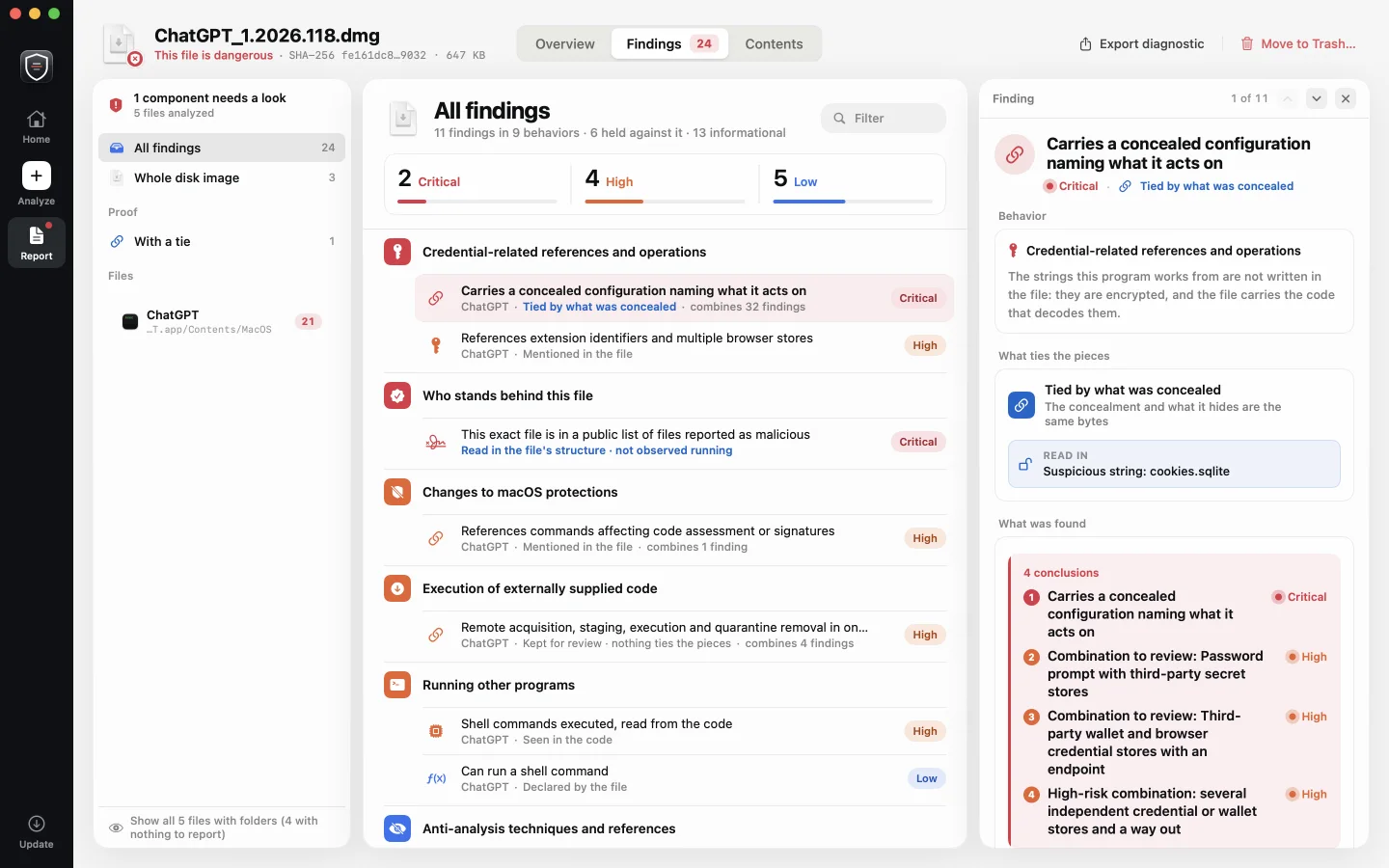
MacSetup.dmg, first seen on November 5, contains a program of the same shape under the plain name Application.app. The two decoded strings are the same, and so are the commands. It too comes out dangerous, 100, by behavior alone.
Fake Grok: the script that checks whether it is being watched
xGrok.dmg holds no compiled program. It holds a script, xGrok.scpt, written in JavaScript for macOS automation. Read by hand, that script downloads a compiled program and dresses it up as “Finder”. One of its functions questions its surroundings in three ways:
ptrace(PT_DENY_ATTACH, …) at offset 13194
dispatchAccess.NSProcessInfo.processInfo.environment tested against DYLD_INSERT_LIBRARIES at offset 13335
NSDate.date then timeIntervalSinceNow (what the function does with the elapsed time is not read) at offset 13787
The first forbids a debugger to attach. The second looks for an injected library, which is how analysis tools work. The third measures time, which stretches when someone steps through the code. All three sit in one function, and that is what relates them. MacVigil’s Critical finding: “A script with no accountable publisher probes its analysis environment from 3 families in one function”. Read by hand, the script also tests what MacVigil does not list: whether it runs in a virtual machine, whether System Integrity Protection is on, and, four times, whether the Mac is set up for a given region (its locale, country, keyboard and time zone).
The most telling part comes next. The script’s real code is not in the file. There are 3,311 numbers, and a function that turns them into text with a key. That key is what another function returns, one whose calls probe the environment the script runs in.
this.Function(resetStreamLog(syncRegistryJob, handlemOV))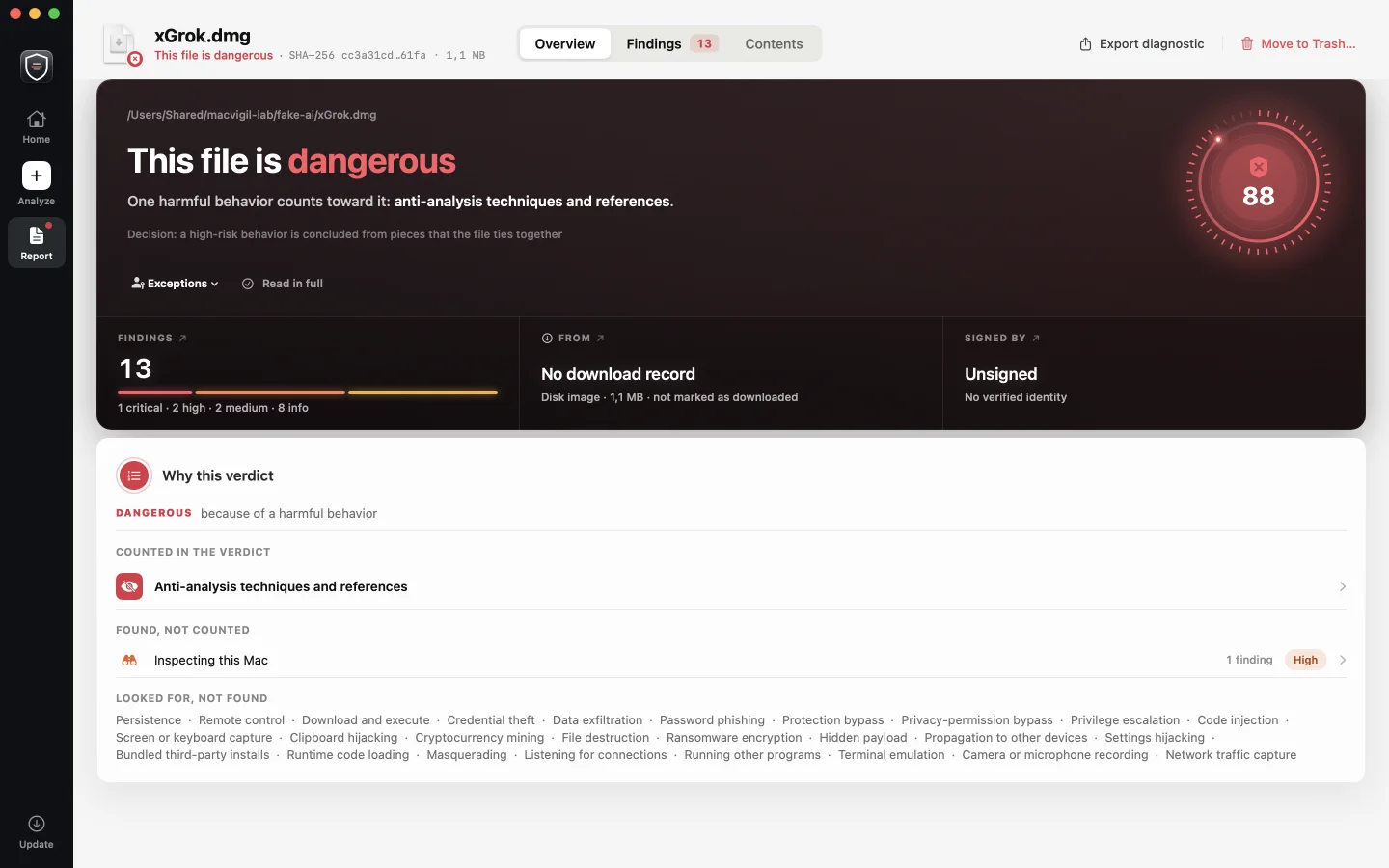
Fake Brave Talk: a program inside the program
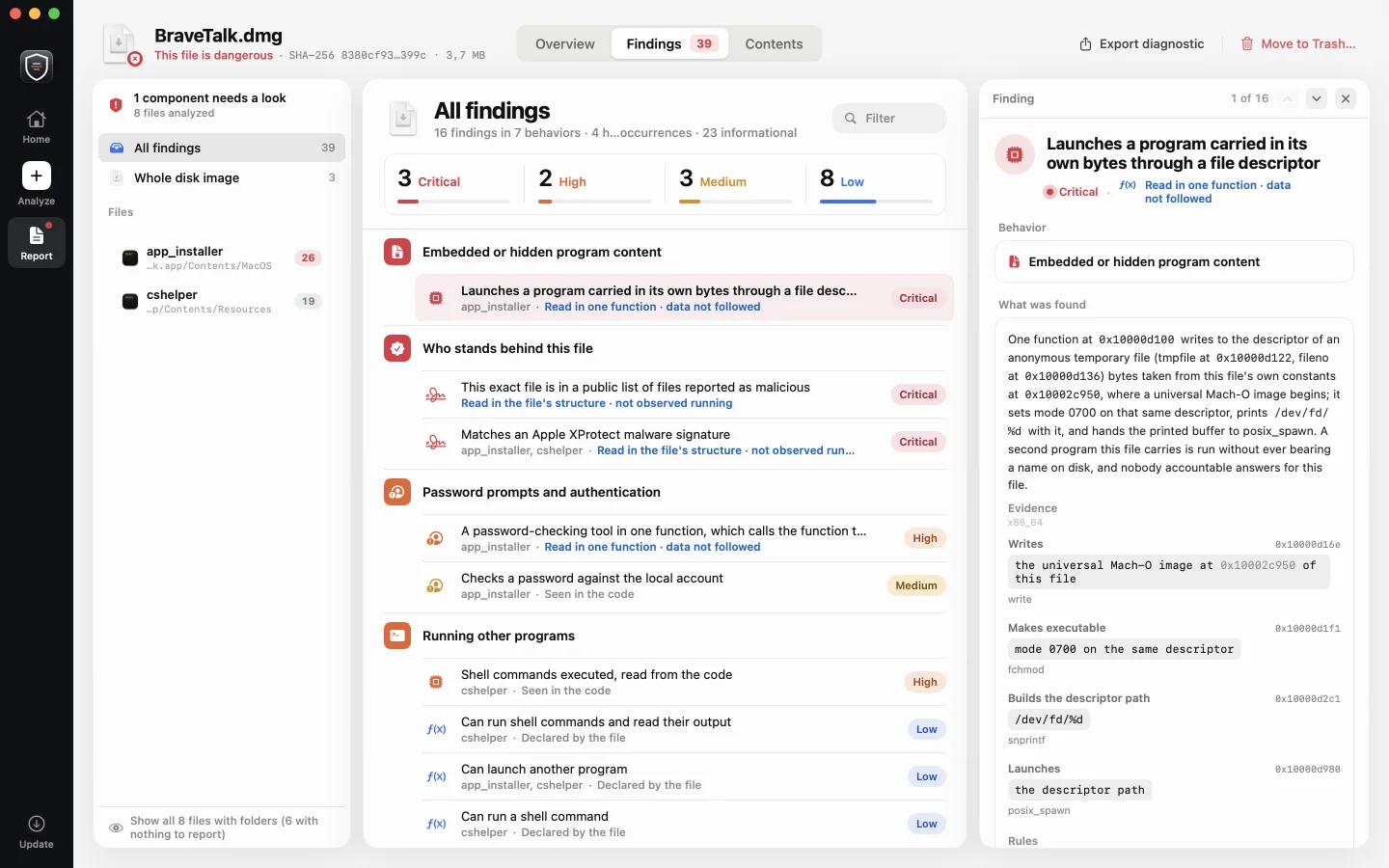
BraveTalk.dmg, first seen on November 3, hides a second program in the data of the first. In a single function of BraveTalk.app’s program, MacVigil reads this sequence of calls:
write at 0x10000d16e : writes the universal Mach-O image that begins at 0x10002c950 (777504 bytes)
fchmod at 0x10000d1f1 : mode 0700 on the same descriptor
snprintf at 0x10000d2c1 : prints /dev/fd/%d with that descriptor
posix_spawn at 0x10000d980 : receives the buffer that path was printed into
The program contains what it needs to write 777,504 bytes of its own data into an anonymous temporary file, make that file executable, then start it through its descriptor number, /dev/fd/…. In MacVigil’s words, “a second program this file carries is run without ever bearing a name on disk”. The same 777 KB program is also in the app as Contents/Resources/cshelper; the copy that is launched is the unnamed one.
The same program has a function that launches /usr/bin/dscl, a tool that checks a password against the Mac’s account, and that calls another function showing a secure text field in a window of its own. Read by hand, that window says “Application wants to make changes. Enter your password to allow this.”, and the password, once checked, is saved to a file.
What each one is written to do
We went back to the four files by hand, without running or mounting them. Each hides its text differently; in each case the text can be recomputed from the code.
Fake ChatGPT and MacSetup: the MioLab stealer. Their decoded configuration names the same servers as the binary in MioLab Stealer, decrypted:
ChatGPT   user id 34   build "github"
MacSetup  user id 124  build "e3fupum14o"
three server addresses (left out here)
The password window says “You need to configure system settings before running application. Please enter password.” The answer is checked with dscl, then the keychain, browser stores, 206 browser extensions, Notes and wallets are zipped and posted to /api/reports/upload. If Ledger Live or Trezor Suite is installed, the program asks its server for a replacement app and puts it in /Applications.
Fake Grok: a key made of nine answers. The script asks nine things about the Mac: is it a virtual machine, is System Integrity Protection untouched, is a debugger attached, and four times, in different ways, is this Mac set up for Russia or a neighboring country (locale, country, keyboard, time zone). The answers are hashed into the key. We computed all 768 combinations: exactly one decrypts the payload, a real Mac, unobserved, outside that region. The decrypted text downloads a program and dresses it up:
…/helxkk/ldes2eFiToQW
~/Library/Application Support/com.apple.finder.worker/Finder.app
CFBundleIdentifier com.apple.finder.worker · CFBundleName Finder
It copies the real Finder icon onto it, marks it as a background app, and opens it. Anywhere else, the script decrypts nothing and does nothing.
Fake Brave Talk: a door left open. This build installs no Brave Talk: its download address is empty. It shows “Application wants to make changes. Enter your password to allow this.”, checks the answer with dscl, saves it in a file shaped like app settings, then starts the hidden program. That program, cloudsyncd by the name it gives itself, sends the Mac’s hardware identifier, name, user and network address to
…/macos/jquery.jsan address made to look like a web script, with the server’s certificate left unchecked. Whatever program the server answers with is decrypted and started from a temporary file that has no name, through sudo when it can. The fake app ends on an invented error: “Shared library version mismatch.”
These files do not say what the two servers send back: neither payload is in them.
How to protect yourself
Download an app from its developer’s site or from the Mac App Store, never from a sponsored link. Before you open a disk image you are unsure about, drop it into MacVigil: it reads the image without mounting it.
The files
| File | First seen | SHA-256 | Verdict by behavior alone |
|---|---|---|---|
ChatGPT_1.2026.118.dmg | September 18, 2026 | fe161dc827d048643ecb43f3acda12b81413a44480ff28a78ae0e88e803e9032 | dangerous 100 |
xGrok.dmg | September 18, 2026 | cc3a31cd52bbcebb2a9bed19c768934535af0eccefd0f81f8d6616e9dd1761fa | dangerous 88 |
BraveTalk.dmg | November 3, 2026 | 8380cf9369598e292bb8403460f183fd038cb25288f57eccc42c4fc8e6f4399c | dangerous 100 |
MacSetup.dmg | November 5, 2026 | 2cfa236c866849e395e4dfc51290b366b1c46f8c003b78df759a0bd5426fae5d | dangerous 100 |
Get the next write-up by email:
More: check a disk image or installer before opening it · the fake password prompt · “macOS cannot verify this app” · check your Mac for malware · all blog posts