Blog · November 15, 2026 · CrashStealer
CrashStealer: anyone can sign as “com.apple”
A program that calls itself Apple’s crash reporter carries a signature anyone could have made, over code scrambled so it can’t be read.
In Activity Monitor you see a process called CrashReporter, with the identifier com.apple.crashreporter. You move on: it’s Apple’s crash reporter. Except this one isn’t Apple’s.
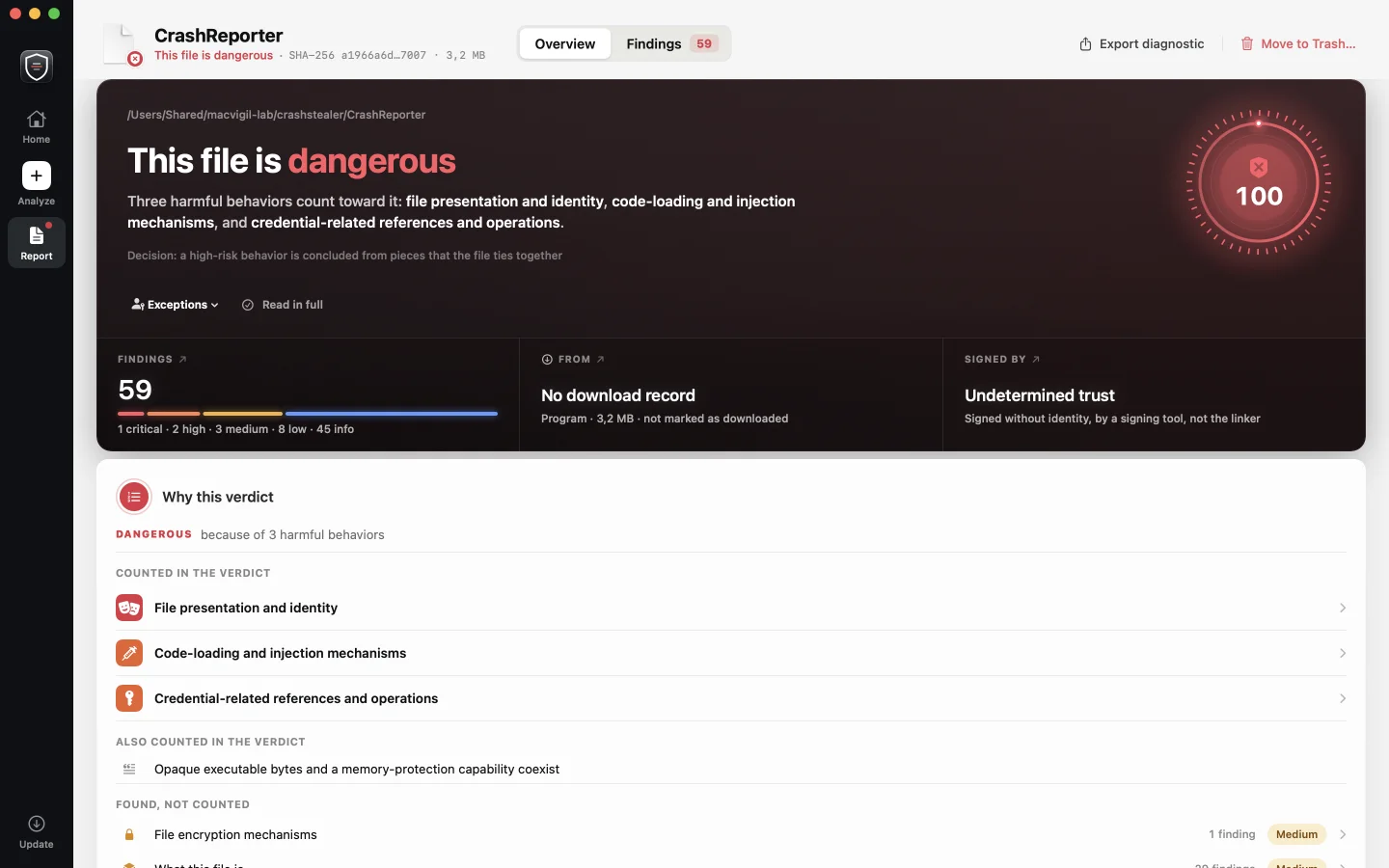
We gave MacVigil the CrashReporter file from the CrashStealer family, a sample we collected. It was never run. It comes out dangerous, 100 out of 100, without checking any list of known files.
A signature that makes a claim, with no one behind it
A code signature on a Mac holds two things that are often confused. The first is an identifier, a plain piece of text that whoever signs picks freely. The second is an identity: a developer’s certificate, issued by Apple, that says who signed.
A so-called ad hoc signature has the identifier but not the identity. It seals the code; it doesn’t say who sealed it. Anyone can make one, with any identifier they like.
Here is what MacVigil reads in this one:
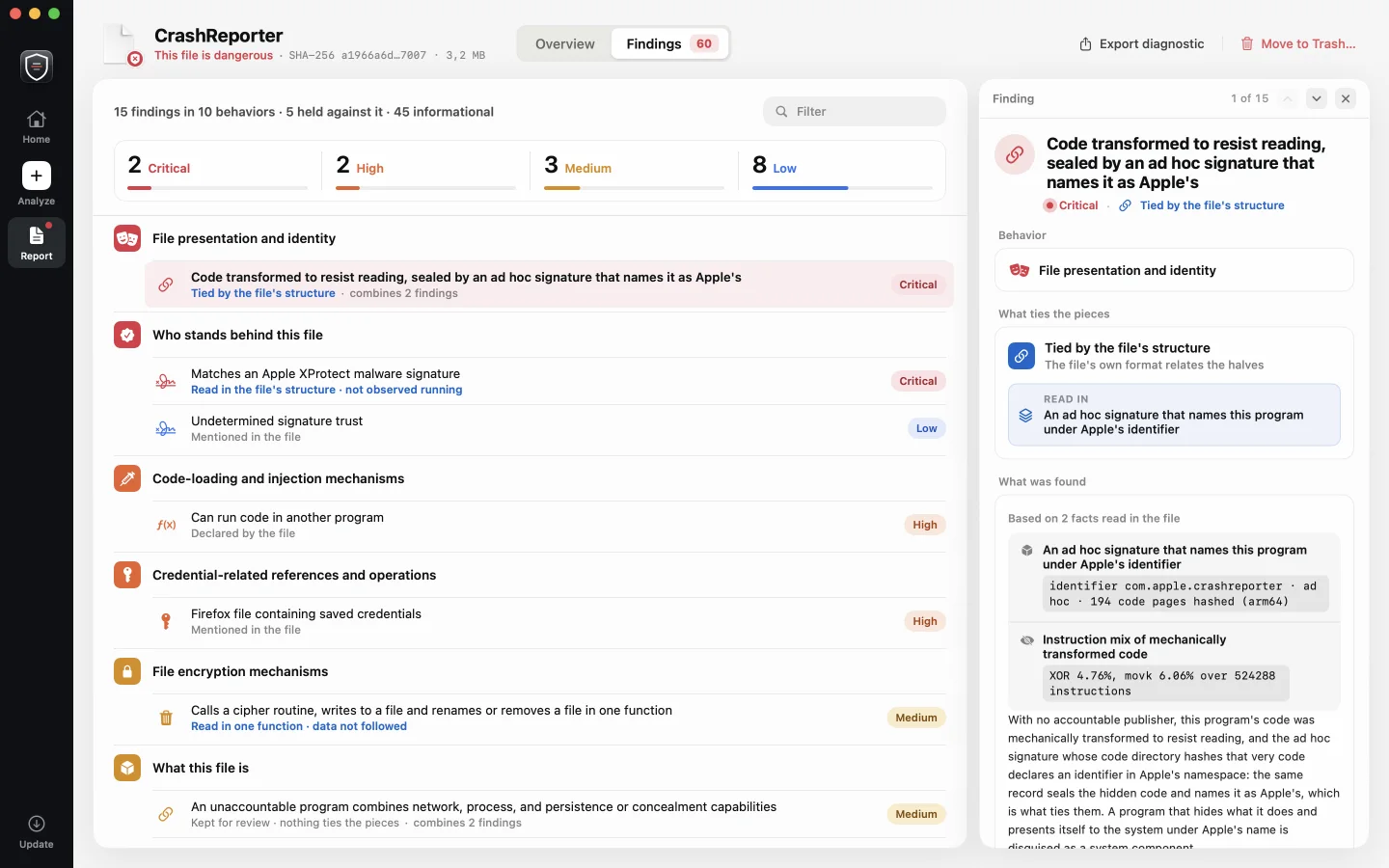
identifier com.apple.crashreporter · ad hoc · 194 code pages hashed (arm64)The identifier sits in Apple’s namespace. The signature is ad hoc. That is not how Apple signs its programs.
What the signature seals
The next question is what lies under that name. MacVigil measures what the code is made of:
XOR 4.76%, movk 6.06% over 524288 instructionsIn an ordinary arm64 program, XOR operations stay at or below about a quarter of a percent of the instructions. Here they make up almost 5%, around twenty times more. That is the trace an obfuscator leaves when it replaces each simple operation with a longer sequence that does the same thing: the program works the same, but it can no longer be read. MacVigil also reports a routine shaped like a string decoder, called with 61 arguments it cannot read.
What ties the two together
Unreadable code alone proves nothing: commercial software protects its licensing this way. A com.apple identifier alone proves nothing either. MacVigil only concludes because the file itself links the two:
“the same record seals the hidden code and names it as Apple’s, which is what ties them.”
The signature holds the fingerprints of the 194 pages of code. So the same record seals that hidden code and presents it as Apple’s. The finding is called “Code transformed to resist reading, sealed by an ad hoc signature that names it as Apple’s”, and MacVigil sums it up this way: “A program that hides what it does and presents itself to the system under Apple’s name is disguised as a system component.”
What shows through anyway
The code is hidden, but a good deal shows through. The program imports thread_create_running, a function that creates and starts a thread in a task whose port the program holds, which can be another process. It contains the text /logins.json, the file where Firefox keeps saved logins. And its authors left their own log messages in clear; they name the program’s routines (see below).
What else the file shows, and where reading stops
We went back to the file with ordinary inspection tools, still without running it. The code is scrambled, but its authors left their own log messages readable, and those name the program’s parts:
collectBrowserData: entry outputDir=%s skipSafari=%d
collectExtensions: entry outputDir=%s
collectFirefoxExtensions: entry outputDir=%s
collectSoftwareTargets: entry outputDir=%s skipTCCProtected=%d
runFileSearcher: entry outputDir=%s skipTCCProtected=%d
Collected %d files in %.1fs, encrypting...
Browser data, browser extensions, a list of “software targets”, a file search in /Documents and /Downloads that writes FileSearch_Results.txt and a GrabbedFiles folder, then encryption and an upload whose duration it logs. The functions the program asks macOS for fit that reading: SQLite, the format of browser databases, with the calls that copy a whole database; a multipart upload through libcurl; AES-GCM; and a password field inside an alert window, driven by a class the authors called _PermDialogHelper.
Two more messages say it wants more than it is given by default: Waiting for Full Disk Access... and Open Settings. A third one is a note from the authors to themselves:
using fallback salt — set CONFIG_CRYPTO_SALT for productionMacVigil also recovers a few strings from the hidden part: Agent initializing version=%s tag=%s c2=, Agent ready botId=%s hwid=%s, and a message about fetching a configuration from a server, with a copy kept on disk. This is a program written to report to a server under a bot identifier.
Where reading stops. One routine is called with 61 hidden strings and only six came out. The server’s address, the browsers, extensions and wallets it looks for, the text of its window, and what the thread_create_running call is aimed at are all in the part nobody here read. So is the code written to memory. The log messages say what the authors named their routines; they do not prove what each routine does. What this file establishes on its own is still what MacVigil says: unreadable code, sealed under Apple’s name by nobody.
How to protect yourself: check a process that carries Apple’s name
In Terminal, on the program’s path:
codesign -dv --verbose=2 /path/to/the/programA real Apple component shows Authority=Software Signing first and Authority=Apple Root CA last. A Signature=adhoc line under a com.apple.… identifier shouldn’t be found outside the system folders.
Simpler still, once MacVigil is available: drop the file into it. The “Signed by” tile says who answers for the file. For this one it shows “Undetermined trust · Signed without identity, by a signing tool, not the linker”: signed without an identity, so by no one.
The file
| File | SHA-256 | Verdict on behavior alone |
|---|---|---|
CrashReporter, Mach-O arm64, 3.2 MB | a1966a6d6f54a025f30d55571d21d6537977ca73ffa734c13494b9c806cd7007 | dangerous 100 |
Get the next write-up by email:
More: what “macOS cannot verify this app” means · check your Mac for malware · all blog posts