What the engine reads.

Format by format, MacVigil opens what macOS software is made of and goes down to the code. Everything is read in memory: nothing is extracted, mounted or launched.

Mac programs (Mach-O)

It reads the instructions, not only the words.

Universal binaries, arm64 and x86_64: headers, imports, sections, signature, then disassembly around the places that matter. MacVigil follows calls and their arguments, jump tables and pointers resolved at run time, to know which function calls what, with which value.

  • Objective-C selectors and method tables, Swift strings and names, Go function tables, Rust toolchains and crates
  • Hidden strings recovered: XOR, encodings, decoding routines simulated by a small private arm64 interpreter that never makes a system call and never runs the sample
  • Packing and tampering: entropy, protected segments, UPX

Apps and what they carry

Each component judged on what it does itself.

The whole bundle is inventoried, with the signature of every executable, its libraries, helpers, launch declarations and URL schemes. Each executable is judged in its own scope: MacVigil does not invent an attack chain between components that have nothing to do with each other.

  • Read the same way: kernel extensions, XPC services, plug-ins, preference panes, Quick Look generators, screen savers, Spotlight importers, system extensions
  • Automator workflows and script bundles too
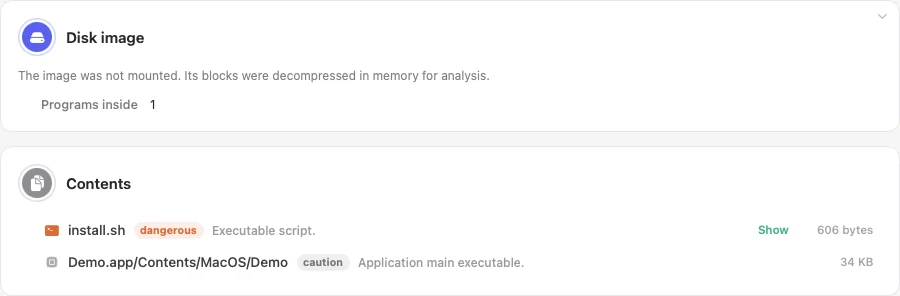
The Contents tab of a disk image: the image was not mounted, its blocks were decompressed in memory
Archives and disk images

Opened in memory, entry by entry.

ZIP (ZIP64 and encrypted too), gzip, bzip2, xz, TAR, cpio and XAR, nested ones included. Disk images are read without being mounted: UDIF tables, zlib, bzip2, LZFSE and LZMA, then HFS+ and APFS volumes rebuilt into named files. Encrypted images are decrypted in memory.

  • Traps named: paths that escape the archive, symbolic links, double extensions, look-alike characters, an entry whose header does not match its name
  • Packed programs opened: PyInstaller, cx_Freeze, Node.js single executables, UPX
Installer packages

Before you type your administrator password.

The package's signature, its Distribution file and the JavaScript in it, the preinstall and postinstall scripts, the Payload (gzip, bzip2, pbzx or xz), the paths it really installs to, and abnormal permissions: files anyone can write, setuid programs.

Scripts

A real shell reader, not a list of keywords.

MacVigil parses the shell's grammar: variables, substitutions, here-documents, subshells, conditions. It rebuilds commands that are assembled, encoded (base64, reversed, eval) or written in several steps, and follows values from one command to the next.

  • Python: the source, and the compiled bytecode (.pyc), read without ever being loaded
  • JavaScript and JXA, including code obfuscated with jjencode, JSFuck, string arrays or flattened control flow
  • AppleScript, as text or compiled (.scpt, decompiled)
  • Perl, and PHP request handlers
  • A script that names other files gets them read too
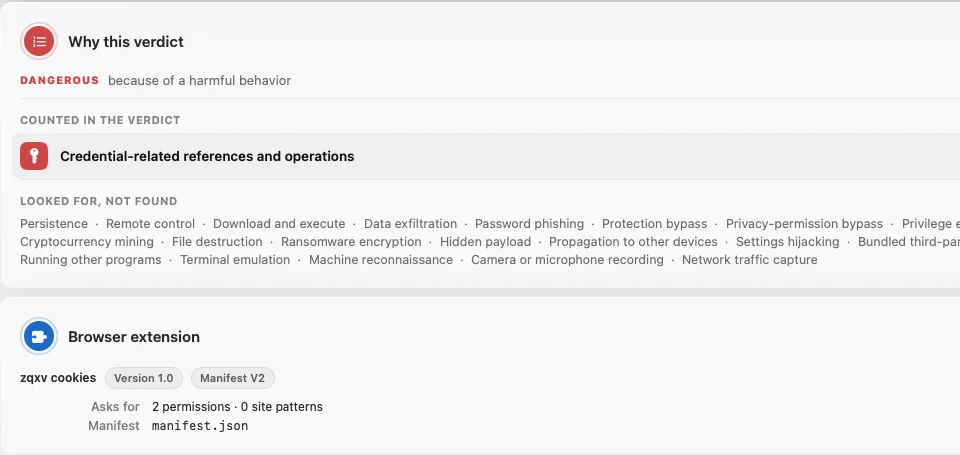
The report of a Chrome extension: dangerous, credential-related operations, and what its manifest declares
Java, Electron, browser extensions

The code inside the code.

Java classes, their constants and bytecode. Electron apps: their ASAR archives and the JavaScript inside, with compiled .jsc files spotted. Browser extensions: Chrome .crx, Firefox .xpi, legacy Safari .safariextz and unpacked folders. The manifest is read as the list of what the extension asks for, then its scripts are analyzed.

Settings and data files

The files that make other things run.

XML and binary property lists: launchd jobs, login items, privileged helpers, environment variables. Configuration profiles. Cron tables, shell histories, git hooks and editor settings. Extended attributes. Python pickles and YAML, read without ever being loaded.

Read it before you trust it.

Drop the next file you are not sure about into MacVigil, and see what it would really do.

Free for 7 days. Then $29.95 a year for 2 Macs, a launch price (the regular price will be $59 a year): see what a license includes.

Free for 7 days, then $29.95 a year (launch price)Requires macOS 15 Sequoia or laterMac with Apple silicon